Bring the timeline
Note when a possible exposure, symptom, test or medicine change happened. Dates help a doctor decide what can be answered now and what needs follow-up.
Read common patient concerns, learn what a CD4/CD8 report can show, and see what information is useful in a consultation. The examples are anonymous composites, not promises about anyone’s diagnosis or treatment.


People looking for HIV, STI and sexual-health care deserve honest context, not a gallery of identifiable stories. We do not publish patient names, phone numbers, addresses, reports, photographs or referring-doctor details.
The reflections below are anonymous composite examples created to show the kinds of questions a private consultation may help with. They use realistic concerns, but they do not identify or represent a specific patient and they do not promise a particular result.
Most people do not need to arrive with a perfect medical history. A clear timeline and the reports you already have are enough to begin.
Note when a possible exposure, symptom, test or medicine change happened. Dates help a doctor decide what can be answered now and what needs follow-up.
CD4, CD8, the CD4/CD8 ratio and viral load answer different questions. One number on its own cannot describe your whole HIV care picture.
A consultation should leave you knowing what to test, monitor, ask your treating team or seek urgently. Do not start or stop prescription medicine from a webpage.
These examples describe the kind of conversation patients may need. They are not verified reviews, and every person’s history, tests and care plan are different.
Read this first: The 12 entries below are composite examples for patient education. They do not identify or represent a specific patient, and they should not be used to choose, change or stop treatment.
I had been reading too many frightening things online. The consultation slowed everything down and helped me understand which test and timing actually mattered.
The conversation was direct but never dismissive. I could ask about my partner and my fear without feeling judged.
I needed help reading a CD4 and viral-load report. I left with questions to ask at follow-up instead of trying to interpret every number alone.
Online consultation made it possible to speak privately from home. I appreciated being told what could be answered remotely and what needed an in-person assessment.
The plan was explained in plain language, including what was still uncertain. That honesty helped me decide my next medical step.
I was worried that one result defined my health. The doctor asked about the full timeline and explained why follow-up can be important.
I felt comfortable discussing symptoms I had not mentioned anywhere else. The discussion stayed focused on care, not assumptions.
The appointment gave me a practical way to organise old reports and medicine questions before speaking to my treating team.
I was told clearly that urgent exposure concerns should not wait for an online page. That safety advice was as useful as the information itself.
The tone was calm and respectful. I did not feel pressured to share more personal information than was needed for the medical question.
I came with a list of internet doubts and left with a shorter, clearer list for my care. The difference was having someone explain context.
The follow-up conversation focused on what could be monitored and when to seek help. It did not promise a particular result.
A clinical report shows several measures at once. Here, the 2023 and 2024 HIV Monitoring sections are shown without identifiers so patients can understand the pattern without treating it as a personal prediction.
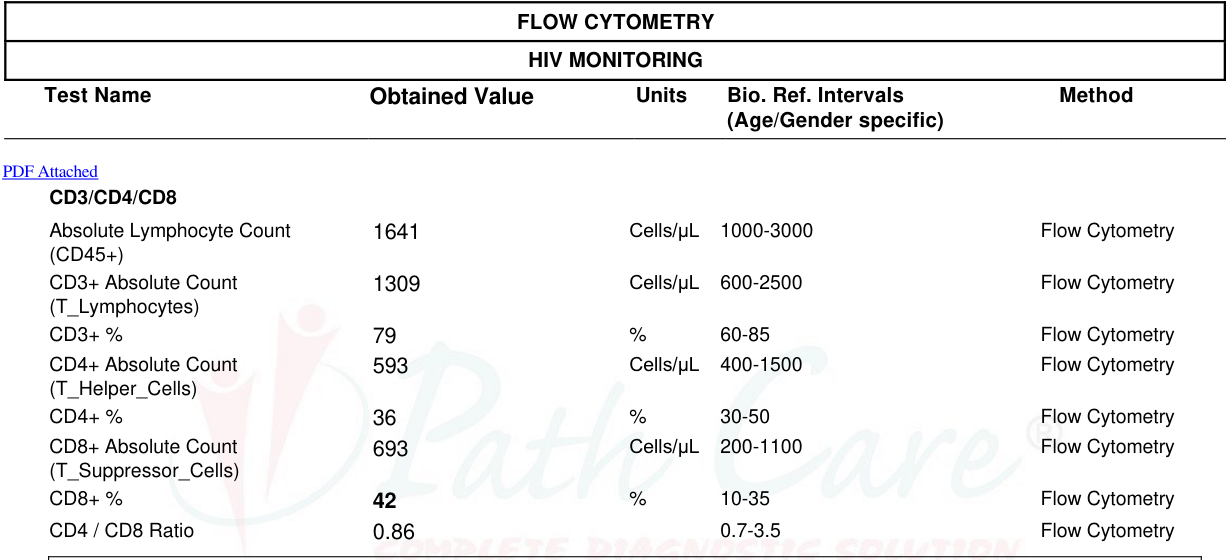
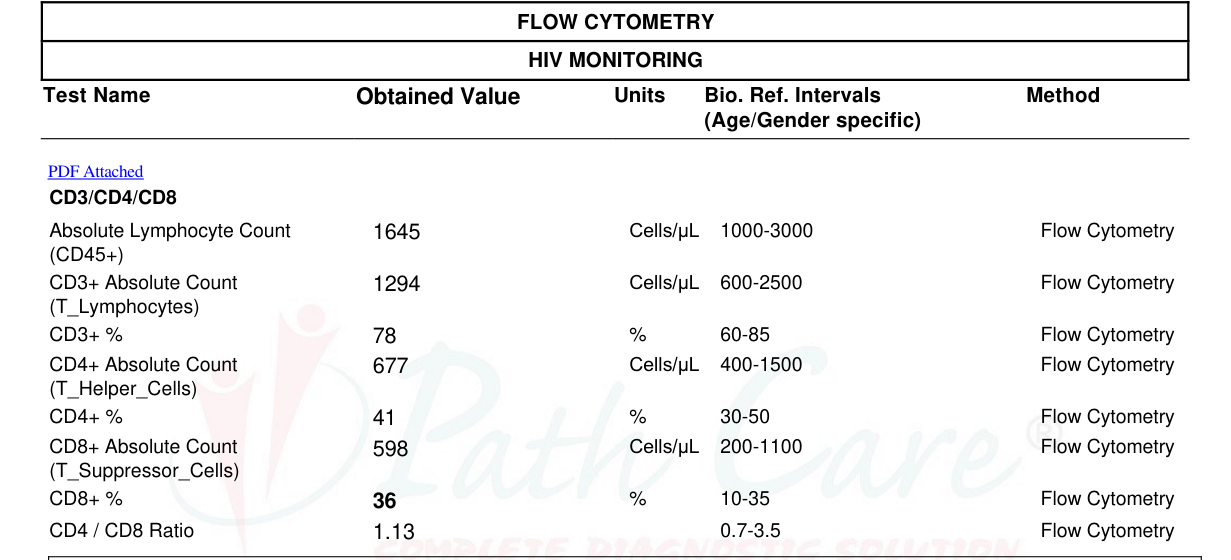
No names, phone numbers, addresses, reports or referring doctor details are included. Only the clinically relevant HIV markers supplied for this educational comparison are shown.
The following anonymized comparison uses the supplied dates 25-Feb-2023 and 28-Jan-2024. It is educational, not proof of outcome and not a substitute for an examination, diagnosis or individual care plan.
| HIV marker | 25-Feb-2023 | 28-Jan-2024 | Change shown |
|---|---|---|---|
| CD4 absolute | 593 cells/µL | 677 cells/µL | Improved · +84 |
| CD4% | 36% | 41% | Improved |
| CD8 absolute | 693 cells/µL | 598 cells/µL | Lower · closer to range |
| CD8% | 42% | 36% | Improved · still slightly above range |
| CD4/CD8 ratio | 0.86 | 1.13 | Improved · above 1.0 |
| Total lymphocytes | 1641 cells/µL | 1645 cells/µL | Almost the same |
| CD3 absolute | 1309 cells/µL | 1294 cells/µL | Stable |
| HIV-1 RNA | <66.9 IU/mL | Not tested | Not comparable |
HIV-1 RNA was reported as <66.9 IU/mL in 2023 and was not tested in 2024. Therefore, a 2024 viral-load comparison is unavailable. This page does not claim that the 2024 viral load was undetectable.
HIV and sexual-health questions can involve timing, symptoms, medicines, exposure history and emotional strain. Share what you know, ask what you do not, and let a qualified clinician decide what needs assessment.

Speak with Dr. Yuvraj Arora Monga’s care team about HIV, STI, sexual-health or report questions in Delhi NCR and online across India.
Camera off is fine for an online consultation. If you have severe or urgent symptoms, seek local emergency care rather than waiting for an online response.